
REPORT · INDUSTRY RESOURCES
Report: Unlocking NYC’s Housing Potential with Accessory Dwelling Units
By: Center for New York City Neighborhoods · Nov 15, 2025
Accessory dwelling unitsAduNycReportResearch
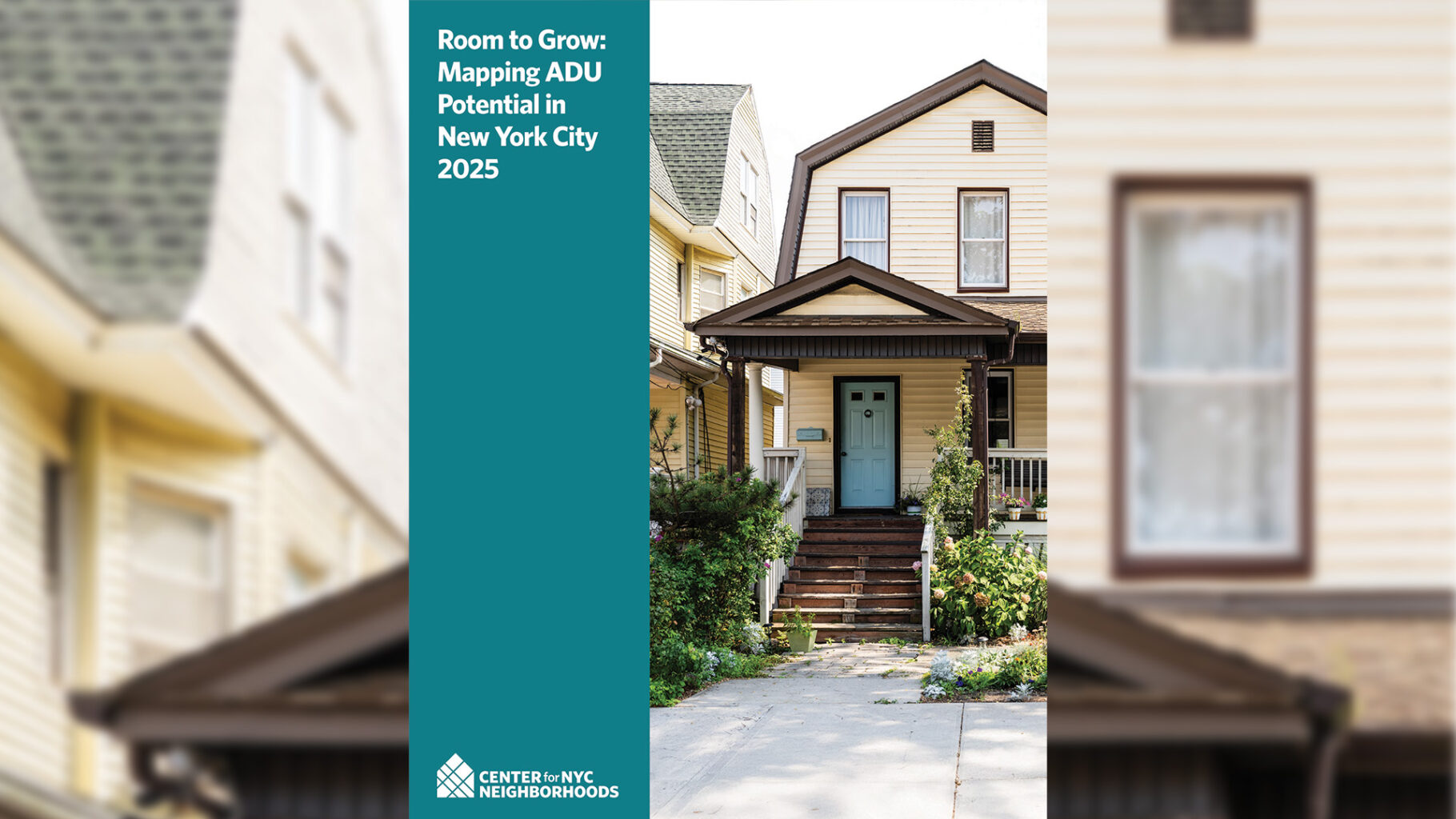
City of Yes unlocked ADUs but equity, financing, and implementation will decide who actually benefits.
Accessory dwelling units (ADUs) can add homes, create affordable living arrangements for community members, keep families and loved ones together, and do so without radically changing neighborhoods. Our new analysis maps where ADUs are structurally feasible across the five boroughs, who is most likely to build them under current conditions, and what it would take to scale ADUs as an equitable tool for home production, stability, and income. The takeaway: zoning reform was a necessary first step, but it won’t deliver broad and equitable community development without targeted support, tailored design pathways, and access to capital.
Roughly
256,353
residential lots that could support at least one ADU type today
46.5%
of New York City’s eligible backyard ADU lots are in Staten Island
43.9%
of New York City’s eligible backyard ADU lots are in Queens
Topline Findings
New York City has demonstrable ADU potential — but it clusters in lower-risk, higher-income areas.
We identify roughly 256,353 residential lots that could support at least one ADU type today; these opportunities are concentrated in neighborhoods with lower poverty and displacement risk, especially in Queens, Staten Island, and parts of Brooklyn. Higher-need areas show markedly fewer eligible lots.
Structural capacity for ADU types significantly vary across neighborhoods.
While we see the potential supply upside for the development of ADU types in NYC — inclusive of backyard, basement, garage, and attic types — factors like built form, zoning, and housing age have resulted in an uneven distribution of potential ADU development according to geographic patterns. For example, backyard ADU lots are most prevalent in Staten Island and Queens which respectively account for 46.5 percent and 43.9 percent of New York City’s eligible backyard ADU lots.
Zoning Reform is Important, But Not Sufficient
ADU legalization via City of Yes opens the door to incremental housing availability, but the experiences of Los Angeles, Portland, and Seattle show that permitting complexity, design standardization, public education, and centralized coordination need to accompany legislation to support ADUs’ success in NYC.
Without supports, ADUs will skew toward already-advantaged homeowners. Households with wealth, time, and professional networks are best positioned to navigate the process. Equity-focused financing, technical assistance, and tenant protections are critical to broaden access and prevent harms.
Summary of Policy Recommendations
Invest in infrastructure for coordinated ADU implementation.
- Create a centralized ADU Implementation Office, housed within the Mayor’s Office.
- Drive interagency coordination while leveraging the New York City Department of Housing Preservation and Development’s expertise.
- Provide support to homeowners through permitting, compliance, technical assistance, and outreach.
Target ADU resources to communities vulnerable to displacement via community ambassadors.
- Target resources through community ambassadors. Prioritize outreach, technical assistance, and tenant protections in high-displacement-risk areas that also have physical capacity for ADUs.
- Design and deliver and ADU pilot program, in partnership with community-based organizations.
Expand access to capital with inclusive loan products.
- Partner with mission-driven lenders and other institutions to underwrite loans on current equity, projected ADU rent, and post-improvement value.
- Pair financing with nonprofit project management and consumer education.
Create pre-approved pathways, specific to NYC topology.
- Create a design catalog of pre-approved architectural plans tailored to NYC’s built environment.
- Establish a public directory of approved ADU professionals, including architects, engineers, and nonprofit housing counselors with region-specific permitting experience.
View the full report.
Margaret Hanson is the report’s author and Ariana Shirvani is the editor, with additional contributions from Yvette Chen.